







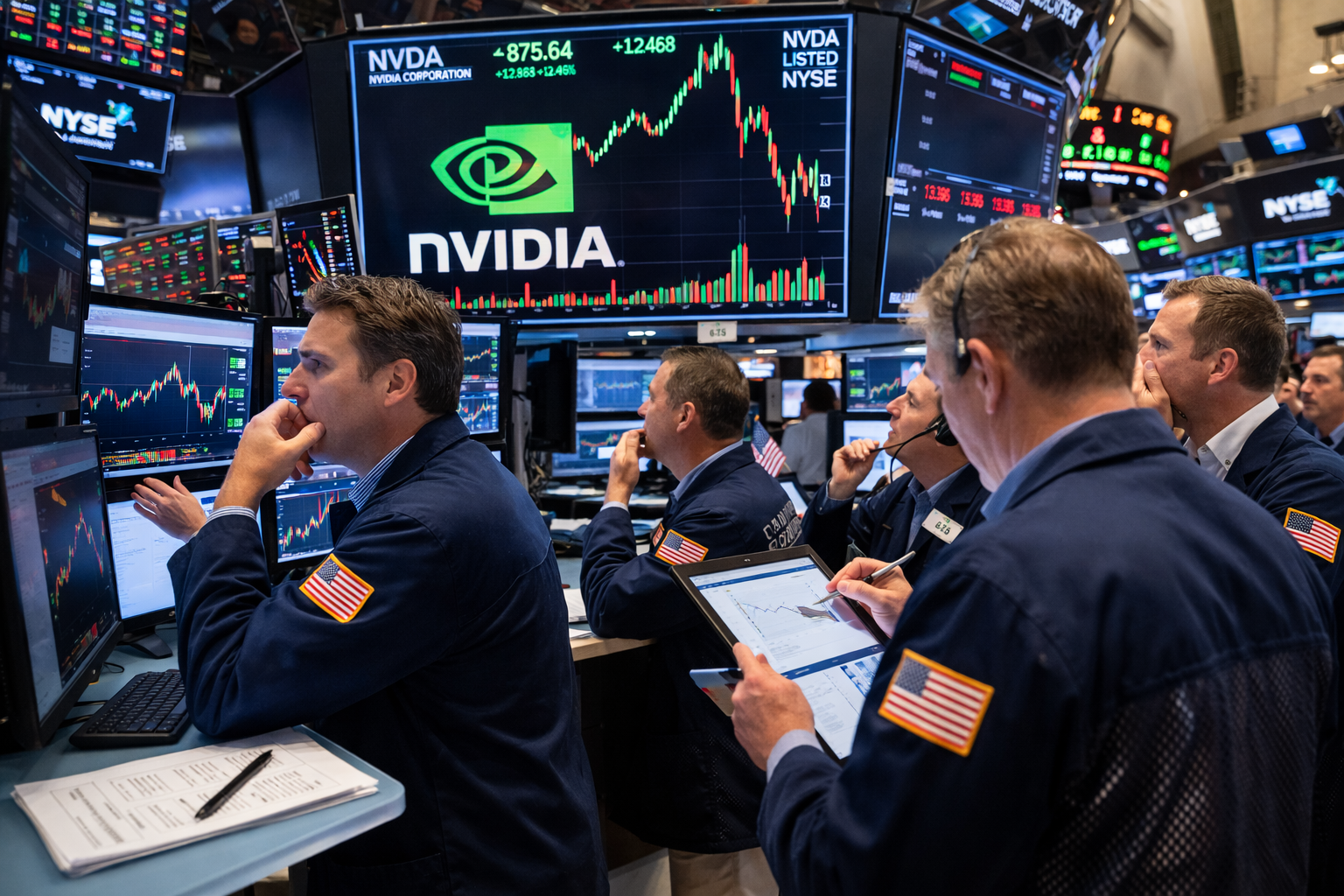
Nvidia stock (NASDAQ: NVDA) fell more than 2% in Tuesday’s early trading, extending a sluggish stretch for the AI chip bellwether even after last week’s blockbuster earnings.
The move doesn’t look like panic selling so much as a market that has already absorbed the “great quarter” headline and is now pushing on the tougher questions.
The investors are now focusing on what’s next, what’s priced in, and what could go wrong.
A $4 billion optics bet raises eyebrows
Nvidia this week unveiled a combined $4 billion commitment to photonics and optical networking, agreeing to invest $2 billion each in Lumentum and Coherent under separate multi-year, nonexclusive deals.
The partnerships include multibillion-dollar purchase commitments and future capacity/access rights for advanced laser and optical networking products, critical components as AI clusters scale.
Strategically, the logic is clear: moving data between GPUs is becoming a bottleneck, and optics is the “pipes” layer of the AI factory.
But in the near term, the market is also doing what it often does with big capex-style moves: asking about timeline and payoff, and whether a multibillion-dollar outlay will translate into measurable revenue or margin benefits.
Post-earnings hangover
Nvidia’s latest results were huge: revenue rose 73% year-on-year in the quarter, and guidance again came in strong.
And yet, the stock reaction has been choppy, a sign that “excellent” is no longer a surprise as it’s the baseline investors assume.
CNBC’s Jim Cramer captured that mood after the selloff that followed earnings, arguing the skepticism isn’t really about Nvidia’s tech lead but about its customers: are the biggest AI spenders actually getting returns fast enough to justify the pace of spending?
That question has only gotten louder as Wall Street tracks hyperscaler capex.
The top hyperscalers are set to boost 2026 AI spending by roughly 70% to around $600 billion, an eye-popping number that cuts both ways for Nvidia.
It supports demand for GPUs, but it also raises the “show me the ROI” pressure on Nvidia’s customers.
Buy Nvidia (NVDA) shares instantly on eToro now.
China risk remains an open wound
The China overhang still hasn’t gone away, and Nvidia itself has effectively told investors not to count on it in the near term.
Nvidia has decided to exclude China from its forecasts amid US export curbs, and other reports have noted the company continues to exclude China data center revenue from guidance.
On top of that, the path to selling high-end chips into China remains messy.
In January, Inventec’s president described a decision on whether Nvidia’s H200 chip will be able to sell into China as “stuck on the China side,” after Chinese customs authorities told agents the chip was not permitted to enter.
Though it remains unclear if that was a formal ban or a temporary measure.
Put together, it’s the kind of uncertainty markets struggle to model: not a clean “good” or “bad” outcome, but a revenue lane that can open or close on politics.
The post Why Nvidia stock is down 2% today: here are top 3 reasons appeared first on Invezz


