




South Korea’s stock market has become one of the biggest beneficiaries of the global artificial intelligence boom, powered by surging demand for semiconductors from technology giants such as SK Hynix and Samsung Electronics.
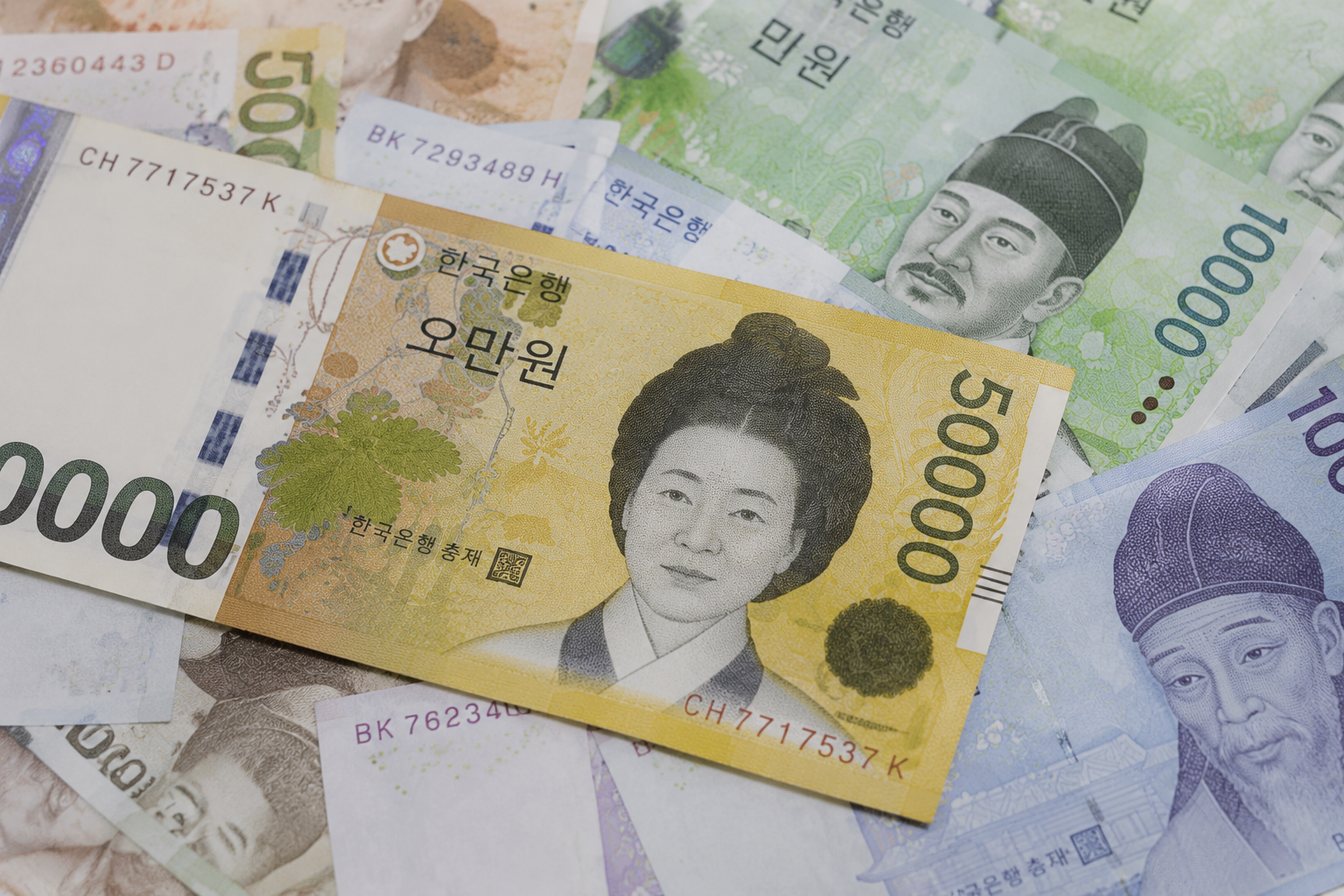
Yet even as the country’s benchmark Kospi index has outperformed every other major equity market over the past year, the South Korean won continues to languish near crisis-era levels.
The disconnect is raising fresh questions about whether traditional relationships between economic growth, equity performance and currency strength are beginning to break down in one of Asia’s most export-driven economies.
The Kospi has climbed over 200% over the past year as investors poured into Korean chipmakers supplying the infrastructure behind the AI race.
But the won has remained one of Asia’s weakest currencies, trading above the psychologically important 1,500-per-dollar level for an extended period — territory previously associated with the Asian financial crisis and the 2008 global financial crisis.
The currency is about 4% weaker than at the beginning of 2026, even as the Kospi crossed the 8,000-point mark for the first time.
The weakness extends beyond the won’s performance against the dollar.
According to the Bank for International Settlements, South Korea’s real effective exchange rate index — a broader measure of a currency’s purchasing power relative to trading partners — fell to 85.06 last month, its lowest level since March 2009.
The won’s real value has now remained below China’s yuan for six consecutive months since October last year.
Conventional economic thinking suggests that rapid growth and booming exports should strengthen a country’s currency.
South Korea’s semiconductor-driven expansion would normally fit that pattern.
Instead, economists say a mix of geopolitical tensions, structural capital outflows and changing investment behavior has weakened the won’s traditional support mechanisms.
The currency’s slide accelerated in late March amid escalating tensions linked to the US-Iran conflict.
Investors moved toward safer assets while foreign funds sold Korean securities, pushing the won to its weakest level since the aftermath of the global financial crisis.
The pressure intensified again in mid-May as Middle East tensions drove oil prices above $100 per barrel.
South Korea imports nearly all of its energy requirements, meaning higher crude prices increase demand for dollars to pay for imports.
“In the short term, the war risk in the Middle East has weighed on the won,” analysts said, noting that the Korean currency is often treated as a proxy for global trade and growth sentiment.
Markets have also focused on South Korea’s commitment to invest $350 billion in the United States as part of a broader trade agreement with Washington.
Investors fear the initiative could generate additional selling pressure on the won because Korean entities would need to convert local currency into dollars to finance those investments.
Foreign selling in local equities has compounded the pressure.
According to Seoul Economic Daily, the Kospi’s market capitalization has expanded to 6,300 trillion won from 2,300 trillion won since President Lee Jae-myung took office.
Yet foreign investors sold a net 110 trillion won worth of Korean equities during the first half of the year.
The Ministry of Finance and Economy said, “Such rebalancing sales by foreigners boosted demand for dollar conversion and pushed up the exchange rate in the short term.”
The Bank of Korea says the composition of South Korea’s overseas assets has fundamentally changed since the mid-2010s.
Historically, much of the country’s current-account surplus flowed into central bank reserves, supporting the won.
Increasingly, however, those surpluses are being recycled into overseas investments by pension funds, institutions and retail investors seeking higher returns abroad.
That shift has coincided with South Korea’s aging population and growing appetite for foreign assets.
As overseas portfolio investment flows grew larger, they began exerting more influence on the won than traditional trade flows.
The BOK said the historical relationship between current-account surpluses and won appreciation began weakening around 2015.
The numbers highlight the shift.
South Korea posted a seasonally adjusted current-account surplus of $85 billion in the first quarter, up 133% from the previous quarter and the highest quarterly level on record.
Yet nearly comparable sums are simultaneously flowing overseas through investments.
Net financial account assets, which include overseas direct and portfolio investments, reached $65.42 billion during the same period.
Retail investors known locally as “Seohak Ants,” along with pension funds and corporations, have increasingly shifted money into foreign markets.
Exporters are also behaving differently.
With expectations growing that the won could remain structurally weak, many companies are holding export earnings in dollars rather than converting them into won or hedging through forward contracts.
Economists say one of the biggest structural problems is weak foreign demand for Korean bonds.
Choi Jae-won, an economics professor at Seoul National University, said in the report by Seoul Economic Daily, “The biggest problem is that foreigners are not buying won-denominated assets in the first place.”
“The impact of weak inflows into the bond market, which is far larger than the stock market, is much greater,” he added.
According to Choi, weak bond inflows have failed to offset dollar demand created by equity outflows and overseas investments, allowing upward pressure on the exchange rate to build steadily.
Another major concern is South Korea’s slowing long-term growth profile relative to the United States.
Economists note that Korea’s recent strength has been driven overwhelmingly by the semiconductor super-cycle rather than broad-based domestic economic momentum.
Since 2023, South Korea’s potential growth rate has fallen below that of the United States.
Lee Nam-kang, an economist at Korea Investment Holdings, said, “In the early 2000s, Korea’s potential growth rate was 5-6%, higher than the US’s 3-4%, but the gap has gradually narrowed, and the US is now ahead.”
“As expected returns on Korean assets fall below those of the US, dollars keep flowing out — that’s the structure,” Lee added.
Economists argue that stabilizing the won will require deeper structural reforms rather than short-term market intervention.
An economics professor who requested anonymity said, “Refraining from populist fiscal expansion and maintaining sound fiscal discipline itself sends a signal of fiscal credibility to foreigners.”
“This sustains external credibility and forms the underlying strength to restore the won’s value over the long term,” the professor added.
