







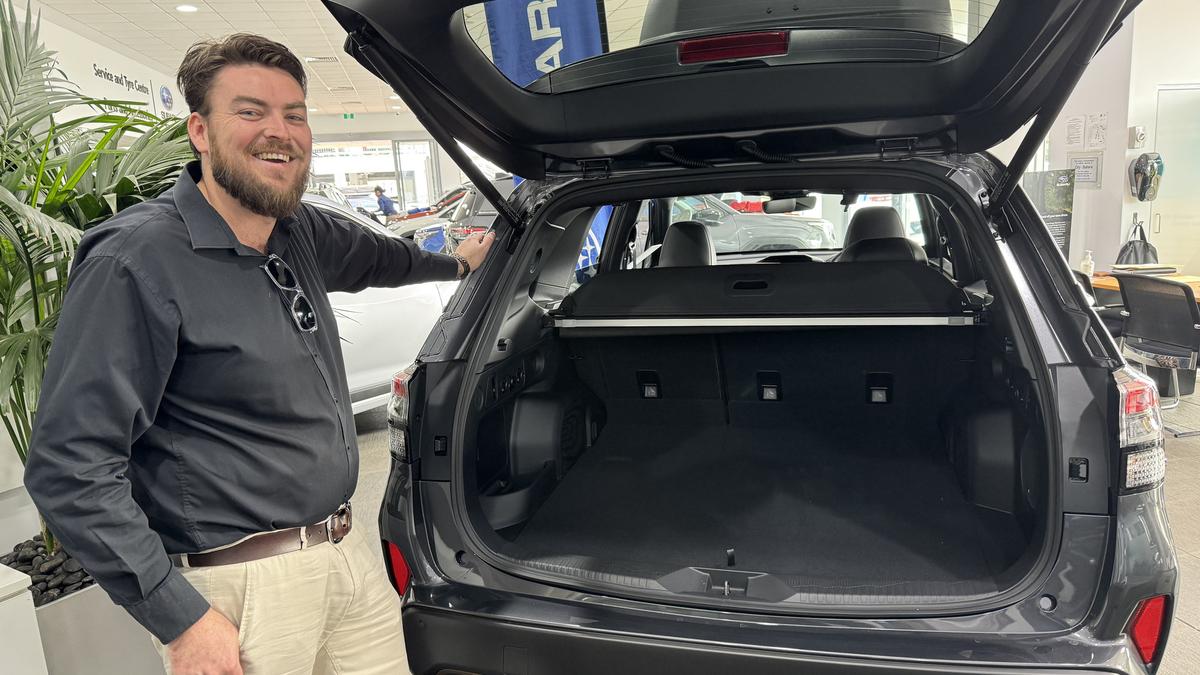
It seems to me the conversation about the 2026 Subaru Forester is being slightly sidetracked by its spare wheel … and lack of it.
The petrol version of the car has a full-sized spare wheel tucked under a flap in the boot compartment, where you’d expect it.
The Strong Hybrid version doesn’t have a spare wheel — it comes with a Tyre Pressure Monitoring System (TPMS), puncture repair kit and a compressor.
And that seems to have transfixed some buyers, particularly as the car is aimed at “adventure families”, leaning on the history of this well-made Japanese car touring the roads and tracks of Western Australia.
Of course, they could just buy a petrol Forester, as our figures here show, which would use 170 extra litres of petrol a year.


Or, as Perth City Subaru’s new car manager Haydn McGrath tells me, if they buy a Strong Hybrid, they have:
+ Roadside assistance in the city.
+ A puncture repair kit and compressor if they can’t get immediate help.
+ The option of a tow bar mounted, swinging spare carrier on the back, which costs $3099.
+ It has to be swung to the side to get in to the boot — but can be stored in the garage when the Forester is being used in the city and easily put on for regional travel.
+ ARB is working on a compartment that fits in the 2026 Subaru Forester Strong Hybrid. It will take a full spare wheel.
+ The Subaru Forester’s roof bars are compatible with roof rack systems that have spare wheel holders.


MORE ABOUT THE TWO CARS
The Strong Hybrid uses a new system that combines a 2.5 litre, naturally aspirated boxer engine with a high-output electric motor, enabling it to use electric propulsion alone for off-road driving.
This system is integrated into the all-wheel-drive drivetrain, giving continuous mechanical AWD.
The petrol version just has the excellent and robust 2.5-litre horizontally opposed (“boxer”) engine.
The kerb weight for the 2026 Subaru Forester Strong Hybrid generally ranges from 1717kg to 1766kg, depending on trim and equipment. The petrol model is around 1622kg to 1651kg, depending on equipment. That’s about 100kg less. Across the range. Remember, it takes power to move weigh.

COMPARING THE PETROL USE
There is a difference of just 1.7 litres per 100km petrol usage between the two Foresters.
+ The petrol Forester has a claimed combined fuel economy of 7.9 litres per 100km, using 91 octane regular unleaded petrol.
+ The Strong Hybrid uses around 6.2L/100km (and has an electric range of over 1000km).
+ For someone driving 10,000km a year, that’s 170 litres more fuel in the petrol version over the Strong Hybrid. At $2 a litre, that would be $340 a year.
+ The Strong Hybrid works out about $3000 more to buy than the petrol Forester.
+ The Australian Government’s National Transport Commission says 1 litre of petrol will produce about 2.3kg of carbon dioxide.


A LAST WORD ON THE FORESTER
There was an old saying that, if you put a set of big tyres on an old Subaru wagon, you could go anywhere.
Subaru Foresters are engrained in the history of touring WA. These are proven, well-made SUVs.
And that is what’s prompted me to visit Perth City Subaru in Victoria Park and talk with Haydn McGrath about “the spare wheel issue” — an issue which a personable salesperson then tells me he’s just been through with a long-time Subaru driver.
Haydn says that the split between petrol and Strong Hybrid purchases at the dealership is about 50/50.
+ There’s the petrol option — which might cost $340 a year extra in fuel, but has a full-sized spare and costs quite a bit less than the hybrid.
+ There’s the Strong Hybrid with a rear wheel carrier for bush trips, or maybe an ARB compartment. Around the city, there’s roadside assistance (and a puncture kit).
Buyers can be transfixed by one issue and the bigger picture gets fogged. We hope this gives clearer vision.


