








Author
Tayler McCracken
Author


Share


The threat of quantum computing to Bitcoin’s security has muted the asset’s price performance significantly from 2025 to 2026, as institutions and retail investors shy away from deploying capital into an asset facing an existential quantum threat. BlackRock even wrote about this in an investment letter in 2025, further spooking the investment community away from the asset.
As a Bitcoiner, the lack of nuance here has been quite frustrating, as we have to ask ourselves, “Is this a real threat?” I certainly believe it is, but the frustration lies in the fact that this is not a “Bitcoin problem” in a siloed vacuum. If quantum computing can crack Bitcoin’s signature scheme (Elliptic Curve Digital Signature Algorithm), specifically the SECP256k1 curve, then far more than Bitcoin is at risk. If a Cryptanalytically Relevant Quantum Computer (CRQC) dropped tomorrow, crypto would be the least of our worries as we would be facing down a systemic collapse of global digital trust.
Every piece of modern digital infrastructure, from your banking app to top-secret military intelligence, relies on the same cryptographic divide we just talked about: asymmetric public-key cryptography vs symmetric cryptography. A true CRQC would breach the entire financial system as it exists today, medical records, state secrets, national defence intelligence, emails, you name it. Bitcoin is barely a rounding error here in the grand scheme of the impact. So why is Bitcoin the only asset whose price is bearing the brunt of the threat as TradFi continues to hit new all-time highs?
Unfortunately, I can’t answer that, but it’s an interesting nuance worth pointing out. While I can’t speak to the breaching of top-secret military files, Wall Street, and bank accounts, we can explore the significance of this threat on Bitcoin.
The Illusion of Safety and Corporate Complacency
I’ve sat through enough enterprise risk presentations to know exactly how the corporate consulting class handles the quantum threat. They treat it like a corporate compliance checklist for the late 2030s. Some suit from a Big Four firm fires up a PowerPoint presentation, points to a neat, linear timeline, and tells institutional investors that Bitcoin is an unassailable fortress. It’s a comfortable understatement designed to protect consulting retainers while investment firms collect fees on Bitcoin ETF inflows, and keep everybody calm. They look at public roadmaps from tech giants, count the slow, incremental additions of noisy qubits, and conclude that we have decades before anyone can touch the ledger.
They are looking at the wrong map.
The Danger of Complacency
This corporate complacency is going to get people absolutely wiped out. The narrative relies on a flawed premise: that quantum development will happen out in the open, following predictable corporate press releases. It completely ignores the reality of raw hardware acceleration happening behind closed doors in state-funded labs. While the industry sleeps, assuming we have a comfortable runway to upgrade the network, the engineering reality has quietly shifted. The timeline has collapsed, and the ledger itself is being weaponized against us.
The Shift in Reality
The root of the problem is a massive misunderstanding of how Bitcoin’s cryptography actually works under the hood. Most people hear “Bitcoin uses SHA-256” and remember a surface-level headline about Grover’s algorithm. They know Grover’s algorithm only provides a quadratic speedup against symmetric hashing, which basically means a quantum computer would only cut the security of SHA-256 down to SHA-128. That’s still incredibly secure. So, they pat themselves on the back, assume the math is on their side, and write off the threat as an academic curiosity.
But they are completely ignoring the asymmetrical signature side of the house. Bitcoin doesn’t just rely on SHA-256; it relies on the Elliptic Curve Digital Signature Algorithm (ECDSA), specifically the secp256k1 curve, to verify ownership. And ECDSA doesn’t get a mild quadratic haircut from quantum computing. It gets completely obliterated by Shor’s algorithm.

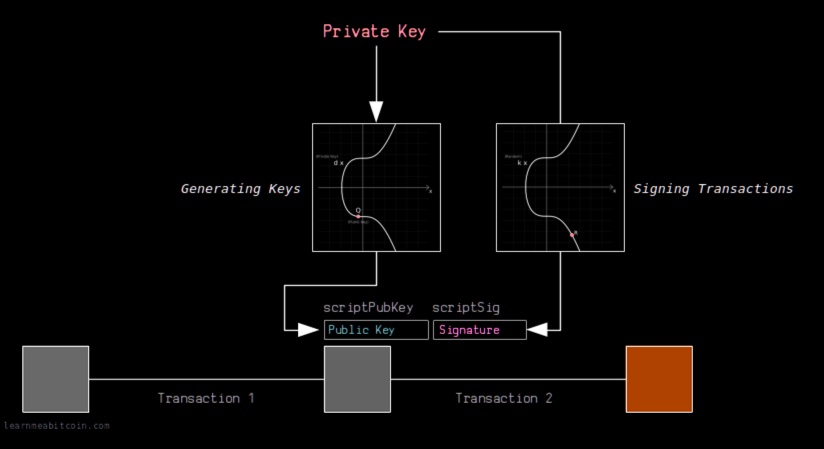
The corporate class treats this like a distant patch update. They figure that whenever the threat gets close, Core developers will just roll out a post-quantum cryptography upgrade via a clean hard fork, everyone will download the new client, and we will move on with our lives. I find this level of casual optimism wild, especially as we have seen in-fighting amongst Bitcoin core developers and a lack of unified solutions. Coordinating a hard fork across a decentralized global network is not like pushing an iOS update to an iPhone. It’s an ideological and logistical nightmare.
I believe the guys on the Bankless Podcast put it best when they mentioned (paraphrashing here) how Bitcoin used to be the place for forward thinking and optimistic builders, dreamers and developers, front running banks and institutions with innovative solutions, and now they are falling behind as banks and institutions are facing the quantum threat head on and providing solutions such as CRYSTALS-Kyber or Falcon standardization for post-quantum computing algorithms, while Bitcoin devs kick the can down the road and squabble amongst themselves.
By treating quantum capability as a far-off compliance issue rather than an active engineering race, the industry has created a massive blind spot. State actors and well-funded adversaries aren’t trying to build a general-purpose quantum computer to run climate models. They are optimizing specific, fast-clock superconducting systems designed to do one thing: solve discrete logarithms on elliptic curves. The moment they hit that threshold, the security model of the entire network implodes. The transparency of the blockchain, the very thing we celebrate as its greatest strength, becomes its fatal flaw. Every exposed public key on the ledger becomes a target sitting in plain sight, waiting for a sniper.
Nine Minutes to Midnight: Weaponizing the Mempool
Academia loves clean, theoretical boundaries. If you read the standard research papers on quantum computing, they almost always split the problem into a neat binary. On one side, you have symmetric hash functions like SHA-256. Thanks to Grover’s algorithm, these only suffer a quadratic speedup, meaning the security drops from 256 bits to 128 bits. Because 128 bits of security is still mathematically unbreakable by any brute-force method we can conceive, academics generally shrug and tell you the base mining layer is fine.
Then they point to the other side: asymmetric digital signatures, specifically Bitcoin’s Elliptic Curve Digital Signature Algorithm (ECDSA) and the secp256k1 curve. They admit Shor’s algorithm completely dismantles this curve, but the consensus is usually that an attacker would need weeks or months of continuous computing power to reverse-engineer a single private key.
The Nine-Minute Window
This binary has a massive blind spot. It treats quantum execution like a slow, back-office decryption project rather than what it actually is: a raw clock-speed race.
Recent physics and hardware simulations show that a fast-clock superconducting quantum computer won’t take weeks to solve a discrete logarithm on the secp256k1 curve. It can do it in roughly nine minutes.

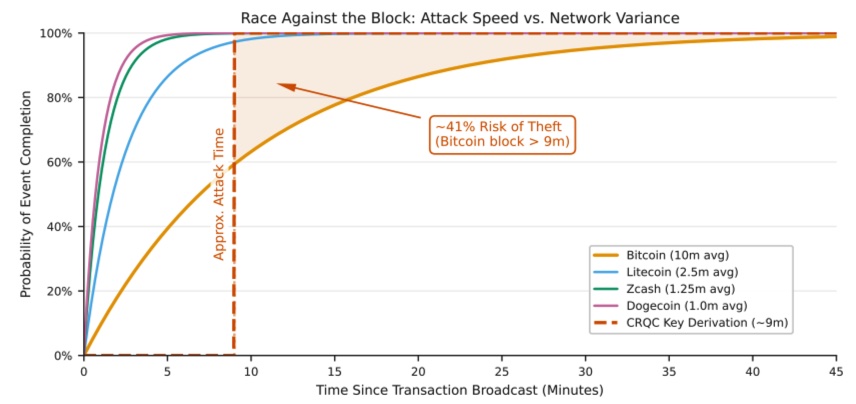
Hence, we should estimate the time required to launch an on-spend attack starting from this primed state at the moment the public key is learned to be roughly either 9 minutes or 12 minutes.
-Source: Google Quantum on Securing Elliptic Curve Cryptocurrencies Against Quantum Vulnerabilities
Nine minutes changes everything. It moves the threat out of the realm of theoretical cryptography and drops it straight onto the front lines of live network operations. To understand why, you have to look at how Bitcoin actually processes a transaction.
Exposing the Public Keys
When you want to move coins, you don’t just magically update the ledger. You sign a message with your private key and broadcast it to the peer-to-peer network. The moment you do that, you are forced to reveal your raw public key. Before that transaction gets baked into an unchangeable block by a miner, it has to sit and wait in the unconfirmed transaction pool; the mempool.
This wait time is the exact window an adversary needs. Bitcoin’s target block confirmation time is ten minutes. If a nation-state or a well-funded cartel spins up a quantum architecture optimized with roughly 500,000 physical qubits, they don’t need to break into your cold storage wallet. They just have to sit on the network peer-to-peer layers and watch the inbound traffic. The mempool becomes an open hunting ground, and your broadcasted transaction becomes the target.
The Automated Sniper Mechanics
Here is how the automated sniper attack works in practice.
You hit send on a transaction. The quantum system intercepts your exposed public key from the mempool gossip at minute zero. While your legitimate transaction sits waiting for a miner to pick it up, the attacker’s machine spends the next nine minutes processing Shor’s algorithm to extract your private key directly from your public coordinates.
Once the machine spits out your private key at minute nine, the attacker has a full sixty seconds before the average ten-minute block timer hits. They instantly forge a new transaction using your stolen key, directing your entire wallet balance to an address they control.
The Front-Running Attack
To guarantee their fraudulent transaction gets processed first, they exploit Bitcoin’s native system rules: Replace-By-Fee (RBF). The attacker attaches an astronomical miner fee to their forged transaction, perhaps giving away 20% of your stack directly to the pool operators. When miners scan the mempool for the next block, they don’t know or care about quantum signatures. They see a transaction offering a massive fee payout compared to your standard transaction. They drop your original broadcast, slide the attacker’s transaction into the template, and seal the block.
By minute ten, your legitimate transfer is rejected by the network as an invalid double-spend, your wallet is drained to zero, and the attacker walks away with your capital. All without ever touching the underlying SHA-256 security of the blockchain itself.
The Cryptographic Irony of Taproot
The Legacy Shield
For years, Bitcoiners took comfort in a specific piece of security engineering called the legacy shield. If you look at old-school Pay-to-Public-Key-Hash (P2PKH) addresses, your public key isn’t sitting out in the open while your coins are stationary. Instead, the protocol takes your public key and runs it through a brutal double-hashing process: first SHA-256, then RIPEMD-160.
What gets recorded on the public blockchain is just the resulting hash. Because quantum computers running Grover’s algorithm cannot reverse a cryptographic hash, your coins are safe while they sit at rest.
The Flaw of Address Reuse
The only time that shield ever drops is during the brief window when you decide to spend those coins. To authorize a transfer, you have to broadcast your raw public key to prove you own the underlying address. If you follow standard security hygiene and never reuse an address, your public key is only exposed to the network for the few minutes it takes to clear the mempool. It is a highly defensive design. The only people who broke this model were users who lazily reused addresses, leaving their public keys permanently exposed on the ledger after their first spend.
The Taproot Trade Off
Then came November 2021, and the network activated Taproot.
I remember the sheer hype around the upgrade. Taproot brought Schnorr signatures, which opened the door for complex smart contracts, better privacy, and cheaper batch transactions. It was a massive technical leap. But it also introduced a devastating, completely unintended cryptographic trade-off. To make those advanced script features work seamlessly, the developers completely discarded the traditional address hashing layer for the primary key-path spend.
This means Pay-to-Taproot (P2TR) addresses do not hide your public key behind a protective hash wrapper. The moment you receive capital to a Taproot address, a tweaked version of your raw public key is written directly into the public ledger inside the locking script. It just sits there, completely bare, for the entire world to see.
This creates a terrifying shift in the quantum threat model, and it is an irony that gets worse the more you think about it. An upgrade designed to push Bitcoin’s privacy and sophistication forward ended up blowing the vault doors wide open for a quantum executioner.
The Exposed Ledger
Because your public key is exposed on-chain from day one, a nation-state adversary does not need to build a high-speed quantum system to race the ten-minute mempool clock. They do not care about your transaction fees or Replace-By-Fee rules. They can just download the entire blockchain data set, scrape every single Taproot output, and run Shor’s algorithm offline. An attacker can sit back in a government-funded lab, pick out a high-value Taproot wallet, and spend days or weeks computing the discrete logarithm to extract the private key. Your cold storage isn’t cold anymore; it is a sitting duck.

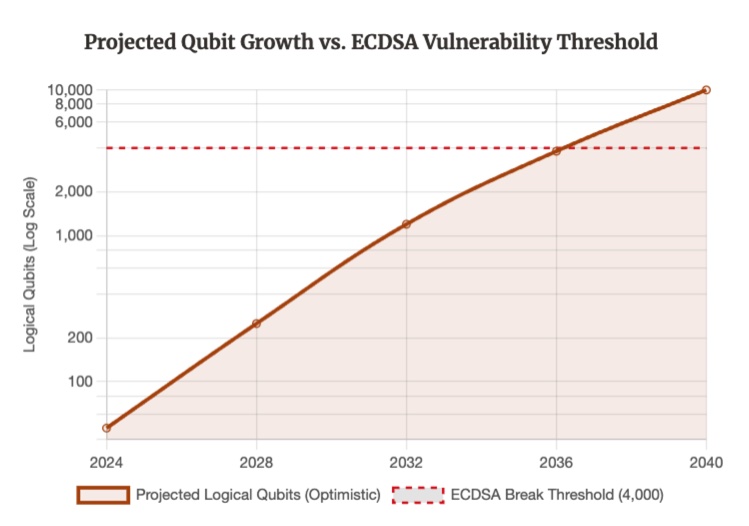
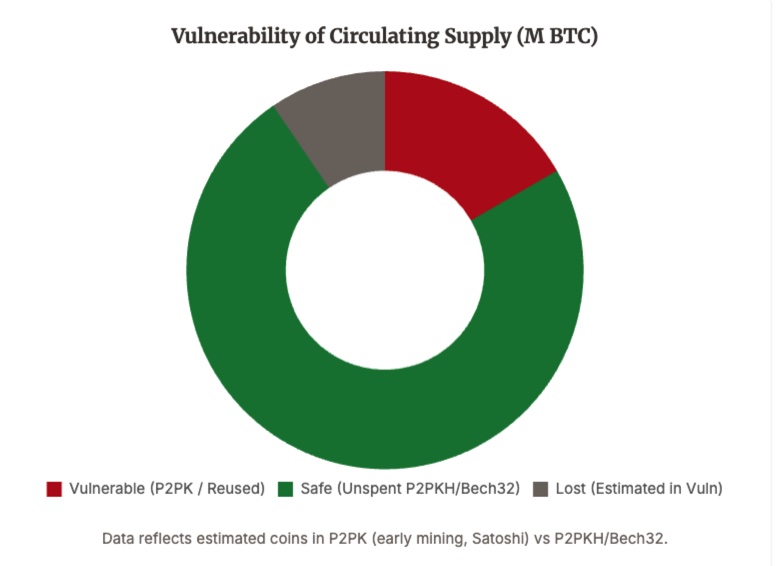
Right now, roughly a third of the entire active Bitcoin supply sits in outputs that expose the public key, including old legacy Pay-to-Public-Key outputs from the Satoshi era. We essentially traded long-term quantum immunity for short-term transaction efficiency. And the worst part? Most modern software wallets default to Taproot automatically, unknowingly painting a massive target on their users’ wallets.
The Sovereign Poison Pill: Bitcoin’s Structural Paradox
The Hardfork Reality
Eventually, Bitcoin will have to abandon the cryptography that made it famous. Core developers understand this, and the theoretical fix is already on the table: migrating the entire network to post-quantum cryptography (PQC) using lattice-based algorithms or stateful hash-based signatures like XMSS and LMS. But you cannot simply soft-fork a fundamental cryptographic overhaul into the blockchain. This requires a sweeping, network-wide hard fork. Every miner, node operator, exchange, and everyday user must actively upgrade their software to recognize the new rules. If you don’t migrate, you get left behind on a dead, vulnerable chain.
Coordinating this upgrade is a massive logistical challenge, but it isn’t the real problem. The real problem is a ticking demographic time bomb embedded directly inside the ledger.
The $100 Billion Target
Right now, there is a massive, $100 billion-plus target sitting in plain sight. It starts with the estimated 1.1 million Bitcoins sitting untouched in Satoshi Nakamoto’s early mining blocks. Add to that roughly two million additional coins trapped in lost legacy wallets, early Pay-to-Public-Key (P2PK) outputs, and reused addresses. Every single one of these coins has its raw public key exposed directly to the public blockchain. They are completely defenseless against a nation-state running Shor’s algorithm.

This sets up a brutal, unavoidable paradox for the network. Let’s look at the two ways this plays out, and neither of them ends well.
The Poison Pill Scenario A (Economic Collapse)
In Scenario A, the developers deploy the quantum-safe hard fork and leave the network open. Active users migrate their funds to new, secure address formats, but the dormant historical coins stay exactly where they are. Because these addresses cannot defend themselves, a state-backed quantum adversary can simply walk in and systematically crack the private keys to Satoshi’s wallets and every lost legacy hoard on the ledger. A hostile intelligence agency suddenly finds itself holding over three million Bitcoins. The moment they dump that supply into the market, liquidity evaporates, investor confidence is crushed, the price crashes to unimaginable lows, if not zero, and the entire economic experiment collapses in an afternoon.
The Poison Pill Scenario B (Ideological Death)
To avoid that disaster, developers will be forced to look at Scenario B. In this setup, the hard fork includes a piece of code that permanently blacklists or freezes any address that fails to migrate by a specific deadline. If you haven’t moved your coins to a quantum-resistant wallet after a few years, your funds are wiped off the ledger or locked forever.
This option is pure ideological suicide.
The entire value proposition of Bitcoin relies on one single unshakeable law: absolute immutability. The rules are set in stone, and no centralized authority can touch your property. The moment a small group of Core developers and dominant mining pools write a rule that arbitrarily confiscates or freezes billions of dollars worth of pristine, early Bitcoin, even if they claim it is for the “greater good” of the network, the core value proposition and very ethos of Bitcoin breaks.
The Ultimate Paradox
If they can freeze Satoshi’s coins to save the market today, they can freeze your coins under government pressure tomorrow. Bitcoin stops being a neutral, sovereign money network and turns into a politically arbitrated ledger, managed by a ruling committee. It becomes the very thing it was built to replace.
This is the ultimate sovereign poison pill. To save the asset’s market value, you have to destroy its soul. To preserve its soul, you have to let a quantum predator drain its wealth. Anyone in the corporate blockchain space who tells you that the quantum threat is just a routine software patch hasn’t spent five minutes thinking through the actual math and philosophy of the ledger. We aren’t looking at a simple technical upgrade; we are looking at a structural trap that threatens the foundational identity of decentralized cash.
The Only Solution: An Ideological Sacrifice
The technical fix is not in question. Solutions exist; the brightest minds are already building post-quantum primitives, from the hash-based SHRINCS framework to the address-hiding mechanics of BIP-360 (P2MR). The hardware timeline has been collapsed by superconducting acceleration, but the engineering challenge is secondary. The true threat to the network is not mathematical, but philosophical.
Bitcoin’s survival hinges on a choice that will either save its value or destroy its soul.
The community can endorse BIP-361, freezing millions of vulnerable legacy coins to preempt the quantum dumping of $100 billion. This preserves the economic integrity of the market, but it establishes a precedent that a central ruling body of developers can confiscate property. Bitcoin becomes a centralized, censorable, permissioned (to a degree) asset, the very thing it was invented to resist.
Or, the community can remain ideologically pure. They can insist on absolute immutability, even if it means allowing a nation-state to siphon off the network’s foundational wealth and systematically crash the asset’s price, along with the trust in the network by investors.
The clock is ticking on a cryptographic migration, but the real countdown is for an ideological compromise. The question is no longer how to implement Post-Quantum Cryptography, but what we are willing to sacrifice for the network to survive: its wealth, or its law?


