








Author
Ahmed Barakat
Author


Share



Bitcoin whale and dolphin balances are flashing bear market signals, with holding structures weakening across major investor cohorts, according to fresh CryptoQuant analysis.
The stall in large-holder accumulation removes a key demand pillar that has historically absorbed sell-side pressure and supported spot prices.
Long-term holder supply has simultaneously hit a record level, a combination that signals potential distribution pressure rather than conviction hoarding.
When whales stop buying and long-term holders sit at peak supply, the marginal buyer burden shifts entirely to ETF inflows and new retail entrants.
CryptoQuant Data Shows Exchange Whale Ratio at Decade-High, What It Means for Spot Demand
The Exchange Whale Ratio, which measures the share of total BTC sent to exchanges originating from the top 10 deposits, recently hit 0.67, the highest reading since October 2015.
That means 64% of all bitcoin flowing to exchanges in that window came from a handful of large addresses.

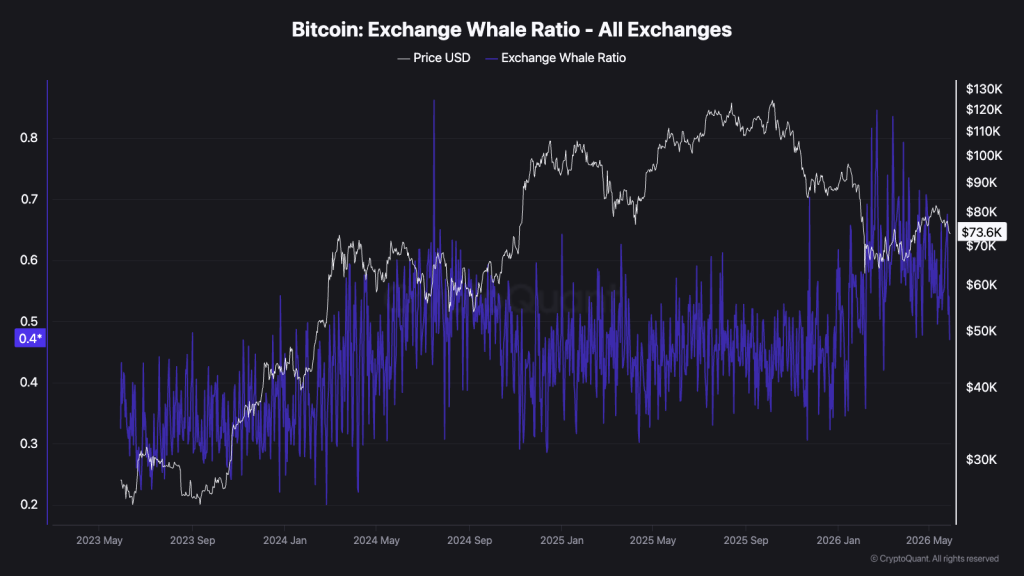
A CryptoQuant-verified analyst identified a three-stage pattern near recent highs: whales accumulated near local lows around $78,000, then distributed between roughly $77,000 and $81,000, with BTC exchange reserves ticking up from approximately 2.677 million to 2.696 million BTC, the highest for that month.
Rising exchange reserves, combined with a 0.67 whale ratio, point to rotation out of positions rather than renewed long-term hoarding.
Meanwhile, the 7-day average of BTC inflows to exchanges has dropped to around 23,000 BTC, roughly 60% below peak levels.
That reduction in raw inflow volume cuts immediate forced-selling pressure, but it does not offset the directional signal when the remaining inflows are so whale-dominated.
Discover: The Best Crypto to Diversify Your Portfolio
Can Bitcoin Price Hold Key Support If Whale Accumulation Stays Flat?
The structural read here is straightforward. Whale buying stalls → spot demand weakens → price becomes increasingly sensitive to ETF flow shocks and macro risk events.
Bitcoin already broke below $73,000 amid ETF outflows and geopolitical risk, a move that aligns precisely with this on-chain setup.
CryptoQuant analysts have flagged $55,000 as a bear market bottom reference zone, a level where prior capitulation and realized losses could attract structural demand if revisited.
That is not a price prediction. It is a framework. But its presence in analyst models signals how wide the risk range has genuinely become.

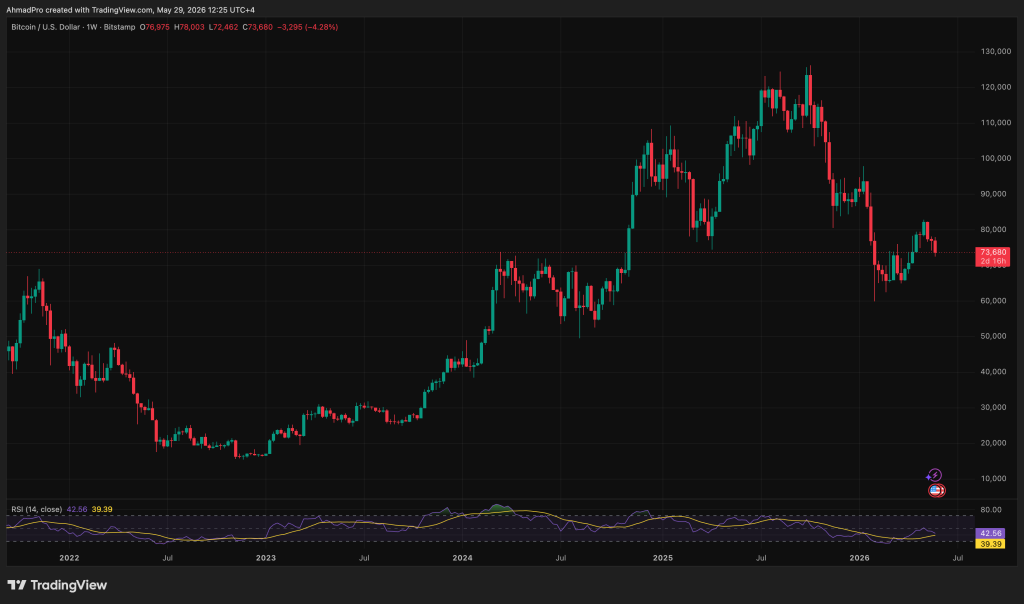
If the whale ratio retreats below 0.55, exchange reserves decline from current levels, and BTC reclaims $81,000 on volume, distribution pressure is exhausted, and accumulation is resuming.
If the whale ratio stays elevated and exchange reserves hold near recent highs, BTC consolidates between $73,000 and $79,000 as ETF demand partially offsets large-holder selling.
Thin stablecoin inflows, persistent ETF outflows, and a loss of the $73,000 zone open a technical path toward the $65,000 to $68,000 support band and eventually the $55,000 reference level CryptoQuant has flagged.
Expert analysis already points to more downside ahead, and the on-chain structure now supports that reading rather than contradicting it.
Discover: The Best Token Presales


