





Author
Ahmed Barakat
Author

Share

Fact Checked by
CryptoNews Editorial Team
Author

Senator Cynthia Lummis publicly tied Bitcoin to America’s $39.2 trillion national debt crisis on June 15, positioning the asset as a generational hedge against currency debasement as the Digital Asset Market CLARITY Act landed on the Senate legislative calendar.
The convergence of a macro fiscal argument with advancing crypto regulation legislation marks the most direct attempt yet to frame digital asset policy as a national balance-sheet imperative.
The CLARITY Act cleared the House in July 2025 with a 294–134 bipartisan vote and passed the Senate Banking Committee 15–9 on May 14, 2026, with Democrats Ruben Gallego and Angela Alsobrooks crossing the aisle.
Placement on the Senate legislative calendar on June 1 formally enables a floor vote. The bill draws hard regulatory lines by assigning SEC oversight to digital asset securities and new token offerings, while giving the CFTC jurisdiction over spot digital commodities, Bitcoin and Ethereum included.
It also builds out registration frameworks for exchanges, brokers, and custodians, requires capital segregation, and shields software developers from liability solely for publishing code, a provision that directly addresses post-Tornado Cash enforcement exposure.
“Our debt is real. Our fiscal trajectory is unsustainable. Bitcoin is one of the few tools that could help right that wrong for younger Americans.”
Lummis said this framing is intentional. She has argued in multiple forums that Bitcoin’s fixed supply makes it structurally distinct from sovereign debt instruments and that younger generations, those inheriting the fiscal consequences of decades of deficit spending, have the most to gain from institutional access to the asset.
Galaxy Research currently puts the probability of the CLARITY Act becoming law in 2026 at 60–75%.
Discover: The Best Token Presales
What the CLARITY Act Actually Changes for Market Structure
The bill’s most consequential provision for active market participants is the SEC–CFTC jurisdictional split. Under the current framework, most tokens operate in regulatory ambiguity, subject to SEC enforcement posture without statutory clarity on whether they qualify as securities.
The CLARITY Act resolves that by creating an activity-based test: assets that are sufficiently decentralized fall under CFTC oversight as digital commodities, removing the perpetual Howey Test overhang that has depressed institutional participation in altcoin markets.
An analysis of the Howey Test implications under the CLARITY Act framework details how this shift recalibrates risk assessment across the altcoin landscape.
On stablecoins, the bill bans passive yield products outright, a provision that earlier drew Coinbase opposition, while protecting activity-based platform usage rewards.
The compromise held, but the passive yield ban remains a live point of tension for firms whose business models depend on it. Exchange customers also gain first claim on custodial assets in bankruptcy, a structural protection the industry has sought since the FTX collapse.
July 4 Deadline Is Slipping, What Actually Needs to Happen
The White House’s July 4 signing target is under significant pressure. Three distinct obstacles remain: unresolved ethics provisions, competing House and Senate committee versions requiring reconciliation, and the 60-vote cloture threshold in the Senate, a procedural bar that demands meaningful Democratic support before recess.
The specific legislative obstacles around the ethics provisions and the July 4 deadline illustrate just how tight the procedural window has become. Lummis herself acknowledged the timeline, stating that “nobody is popping the champagne quite yet.”
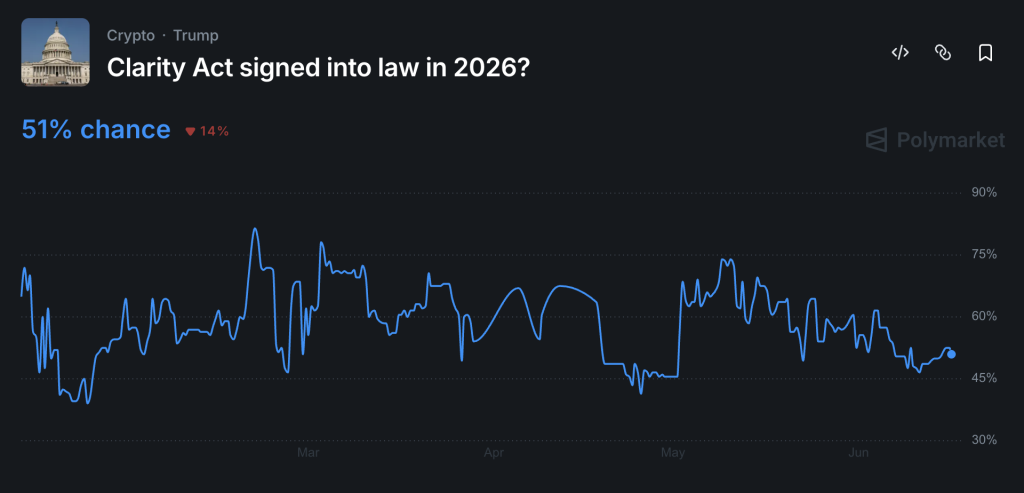
The Senate and House versions also diverge on the SEC–CFTC balance. The Senate Banking discussion draft leans more SEC-centric, giving the commission primary authority over “ancillary assets” and requiring joint SEC–CFTC rulemaking on margining and disclosures, a meaningful departure from the House bill’s CFTC-forward approach.
Reconciling those competing texts is the real legislative bottleneck, independent of the floor scheduling question. If the July 4 window closes without passage, most observers expect the effort to reset entirely into the next Congress, pushing comprehensive digital asset legislation toward the late 2020s.
Over 200 crypto firms have formally urged Senate leadership to schedule a floor vote promptly. Circle has backed the bill publicly, and institutional accumulation of Bitcoin as a treasury asset, Strategy’s continued Bitcoin purchases being the most visible example, aligns directly with the fiscal hedge narrative Lummis is running on Capitol Hill.
The next concrete signal to watch is whether Senate Majority Leader John Thune schedules floor time before the recess window closes, or whether the ethics and jurisdictional disputes force the bill into fall negotiations.
Discover: The Best Crypto to Diversify Your Portfolio
