




U.S. prosecutors said Thursday they have dismantled an international firearms trafficking operation that allegedly funnelled dozens of illegally-obtained guns from New Hampshire into Canada, where many of the smuggled weapons were later found at crime scenes.

Erin Creegan, the U.S. Attorney for the District of New Hampshire, said five defendants have pleaded guilty and eight others have been charged with federal firearms offences in relation to the alleged scheme, which prosecutors say occurred between the summer of 2021 through “at least” October 2024.
“The defendants allegedly treated the northern border as a pipeline for illegal gun trafficking,” Creegan said in a statement. “It is not.”
The U.S. Bureau of Alcohol, Tobacco, Firearms and Explosives (ATF) and U.S. Homeland Security Investigations said investigators have identified approximately 51 firearms potentially trafficked into Canada through Vermont and the Akwesasne Mohawk Indian Reservation in New York, where all eight additional defendants charged in the grand jury indictment are residents.
“Several” of those weapons were subsequently recovered at various violent crime scenes in Canada, investigators said, including a kidnapping and attempted murder investigation in Montreal.
According to prosecutors, the Akwesasne Mohawk defendants allegedly enlisted a Vermont man, Justin Jackson, to purchase firearms on their behalf.
Jackson was legally prohibited from purchasing firearms, however, so he tasked three others — Melissa Longe, Dustin Tuttle and Caleb Wilcott — to obtain the weapons from licensed firearm dealers in New Hampshire and elsewhere in the region.
All four of those individuals have pleaded guilty to straw purchasing of firearms, which carries a maximum prison term of 25 years, and firearm trafficking and possession charges.
A fifth person, Doug Mulligan of Massachusetts, pleaded guilty to being a felon in possession of a firearm. His plea agreement acknowledged he left a note for the targets of the investigation that read, “ATF is watching U.”
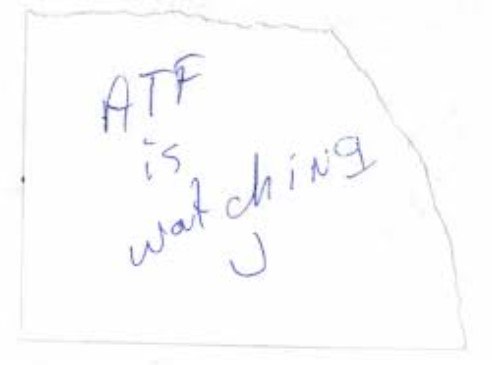
An image from U.S. prosecutors of a note reading “ATF is watching U” allegedly left by a defendant for targets of a federal firearms trafficking investigation announced by the U.S. District Attorney for New Hampshire on May 14, 2026.
U.S Department of Justice
Of the eight Akwesasne Mohawk defendants, four were taken into custody on Tuesday, authorities said, while the others remain fugitives at large. All eight are charged with straw purchasing and firearms trafficking.
The indictment says the Canada-U.S. border region near the Akwesasne reservation, which also covers Cornwall Island in Ontario and Saint Regis Mohawk tribal lands in Quebec, “is a known smuggling corridor.”

Get daily National news
Get daily Canada news delivered to your inbox so you’ll never miss the day’s top stories.
“Drugs, guns, and people are smuggled through the Akwesasne reservation utilizing Cornwall Island which is part of the Akwesasne reservation,” the indictment says.
The ATF and Homeland Security worked with the Canada Border Services Agency, Ontario Provincial Police, Sûreté du Québec, Saint Regis Mohawk Tribal Police and Akwesasne Mohawk Police Service in the investigation.
Canadian agencies said they regularly share intelligence with U.S. authorities to disrupt cross-border criminal networks.
“This investigation highlights the value of integrated enforcement teams and strong international partnerships,” Ontario Provincial Police Chief Supt. Mike Stoddart said in a statement.
ATF officials claimed the arrests and indictment proved U.S. and Canada border security agencies were working more closely than ever before.

A CBSA spokesperson confirmed to Global News the agency “shared information from our systems and expertise with our partners, in accordance with legal requirements,” as part of the U.S. investigation. CBSA resources were also allocated to joint teams involved in the case, including Quebec’s firearms trafficking and tracing teams.
CBSA data says 852 firearms were seized at the U.S. border in the past fiscal year, down slightly from 942 the year before.
However, the number of firearms seized by CBSA during a search warrant executed within Canada — 335 — shot up from 96 in the 2024-25 fiscal year.
U.S. authorities have been scrutinizing criminal activity at the Canadian border since U.S. President Donald Trump was re-elected in 2024. His initial tariff threats prompted the federal government to step up border security, including with a $1.3-billion investment and additional legislation passed this year.
The CBSA said Thursday said it is on track to hire 1,000 new officers within three years, with over 100 joining the front lines so far since the recruitment plan was announced in October.
“Criminals try to exploit the border both ways,” spokesperson Luke Reimer told Global News in a separate statement Wednesday. “Canada and the U.S. count on each other to share information and identify and protect against threats.
“Over the past few years, there has been an increase in guns, fentanyl, methamphetamine, and cocaine seizures coming from the U.S.”
Earlier this week, the head of the U.S. Drug Enforcement Administration said his agency was “keeping our eye on Canada” as Mexican cartels ship their fentanyl manufacturing and trafficking operations to the north, including shipping precursor chemicals from China and India to Canada.
A recent Criminal Intelligence Service Canada report said the Canadian criminal marketplace “remains largely dependant on cross-border smuggling, mainly of illicit drugs and precursor chemicals, primarily from China, India, Mexico, and illicit firearms from the U.S.”
The RCMP told Global News on Thursday that it works closely with U.S. and Five Eyes partners to disrupt cross-border and international crime groups.
“Organized crime groups seek to increase profit however possible, and new trends continue to emerge as long as demand exists,” the agency said in a statement.
“Our shared goal is ensuring that these organized crime groups do not expand their operations and gain a foothold within Canada.”

